Hello, welcome to the official website of Zhan Yao Spraying!

Customer service hotline
+86 185 3326 7656
WeChat:+8618533267656
Mobile:+86 185 3326 7656
Whatsapp:+8618533267656
Email:info@powder-coatingline.com
Address:No. 55, Airport Road, Changshou Street, Xinle City, Shijiazhuang, Hebei Province
Poor curing is a common cause of powder coating quality problems. Finished parts may have insufficient hardness, poor impact resistance, weak adhesion, or inconsistent coating performance. When these problems appear, increasing the oven temperature is often the first adjustment operators consider.
However, this does not always solve the problem.
A powder coating oven can reach its preset temperature while the workpieces remain below the required curing temperature. In other cases, the actual problem may come from the powder formulation, excessive film thickness, poor pretreatment, or uneven heating.
The correct approach is to identify the failure first, verify the actual curing conditions, and then adjust the process according to the cause.
How to Identify Poor Curing in Powder Coating
Before changing production parameters, it is important to understand what the coating problem indicates.
Common signs of insufficient curing include:
Low coating hardness: The coating is softer than expected and may scratch or deform more easily.
Poor impact resistance: The coating cracks or chips under impact.
Insufficient chemical resistance: The coating performs poorly when exposed to chemicals specified for the application.
Inconsistent coating performance: Parts from the same production batch show different coating properties.
These symptoms can indicate under-curing, but they are not conclusive on their own. For example, poor adhesion can also result from inadequate pretreatment, contamination, or an incompatible coating system.
Therefore, coating appearance and a single physical test should not be used as the only basis for diagnosing curing problems.
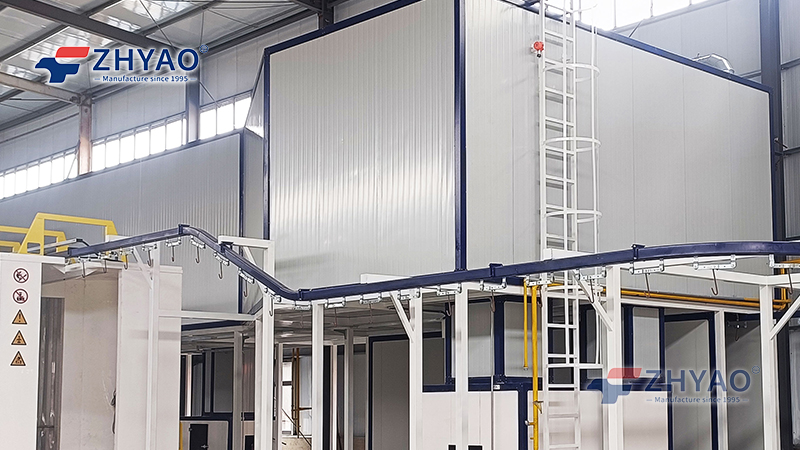
(ZHYAO Henan Shenhuo Spray Coating Project)
Check the Actual Workpiece Temperature First
One of the most common mistakes in troubleshooting is relying only on the temperature displayed by the oven control system.
The displayed temperature generally represents the temperature measured by an oven sensor. It does not necessarily represent the temperature of the metal workpiece.
Powder coating requires the workpiece to reach the temperature specified by the powder manufacturer and remain at that temperature for the required curing time.
This distinction is particularly important when processing:
Thick steel components with high thermal mass.
Large workpieces with complex structures.
Parts with different thicknesses on the same conveyor.
Heavy products that absorb heat more slowly than smaller components.
A practical way to verify curing conditions is to use a temperature data logger with thermocouples attached to representative workpieces.
Measure the temperature at different positions, especially on thicker sections and areas that are difficult to heat. Compare the recorded metal temperature curve with the powder manufacturer's curing specifications.
If the workpiece reaches the required temperature too late or does not maintain it for long enough, the curing process needs adjustment.
Check Conveyor Speed and Effective Curing Time
In a continuous powder coating line, conveyor speed directly affects the time workpieces spend inside the curing oven.
If the conveyor moves too quickly, parts may leave the oven before completing the required curing cycle.
However, simply reducing conveyor speed is not always the best solution. It may reduce production capacity and create bottlenecks in other sections of the line.
The relationship between conveyor speed and curing time should be evaluated together with:
The effective heating length of the oven.
Workpiece dimensions and weight.
Actual metal temperature.
Required curing time.
Production loading conditions.
For example, if thicker workpieces require more time to reach the curing temperature, the existing conveyor speed may no longer be suitable.
In this situation, engineers should determine whether the production conditions can be adjusted or whether the heating capacity and oven configuration need improvement.
Inspect Oven Temperature Uniformity and Air Circulation
Even when the average oven temperature appears normal, uneven temperature distribution can cause inconsistent curing.
Some workpieces may receive sufficient heat, while others remain below the required temperature.
Several factors can contribute to this problem:
Poor hot-air circulation inside the oven.
Blocked or improperly positioned air outlets.
Damaged or inefficient circulation fans.
Uneven heating between different oven zones.
Excessive or poorly distributed workpiece loading.
The correct inspection method is to measure temperatures at multiple positions rather than relying on a single sensor.
If temperature differences are significant, check the circulation system, air distribution structure, heating elements or burners, and control sensors.
Adjustments should aim to provide stable and reasonably uniform heating throughout the effective working area.
Check Powder Type and Coating Thickness
Not every powder coating material uses the same curing conditions.
Different powder formulations may require different curing temperatures and times. Even products within the same general powder category can have different specifications.
Before changing oven settings, confirm the following:
The powder type and product specification.
The recommended curing temperature and time.
Whether the specified temperature refers to actual metal temperature.
The applied coating thickness.
Whether the powder has been stored and handled correctly.
Excessive coating thickness may also affect the final coating properties and should be checked against the powder manufacturer's recommended application range.
Avoid applying a universal curing temperature to all powder coatings. The correct process must follow the technical data sheet of the specific powder being used.
Do Not Confuse Poor Curing with Pretreatment Problems
Poor adhesion is sometimes incorrectly diagnosed as insufficient curing.
However, the coating process includes several stages, and problems in earlier stages can also affect the final result.
For example:
Oil or grease remaining on the workpiece can interfere with coating adhesion.
Inadequate rust removal or surface cleaning can weaken the coating system.
Improper chemical pretreatment can affect corrosion resistance and adhesion.
Surface contamination between pretreatment and powder application can cause defects.
If the workpiece reaches the specified curing conditions but adhesion remains poor, inspect the pretreatment process before increasing the oven temperature.
A proper diagnosis should consider the complete coating process rather than treating the curing oven as the only possible source of defects.
How to Correct Poor Curing Without Creating New Problems
Once the cause has been identified, corrective actions should target the actual problem.
Identified problem | Recommended action |
|---|---|
Workpiece temperature is too low | Check heating capacity and workpiece heat load |
Curing time is insufficient | Adjust conveyor speed or effective heating time |
Uneven curing across the oven | Inspect air circulation and temperature distribution |
Powder specification is not followed | Correct curing settings according to the technical data sheet |
Coating thickness is excessive | Adjust powder application and verify film thickness |
Poor adhesion despite sufficient curing | Inspect pretreatment and surface cleanliness |
After making adjustments, process conditions should be verified again using temperature measurements and appropriate coating performance tests.
Avoid making several major changes simultaneously. Otherwise, it becomes difficult to determine which adjustment actually resolved the problem.
The goal is not simply to make the oven hotter, but to establish stable curing conditions that match the powder material, workpiece characteristics, and production requirements.
FAQ
1. Why does powder coating remain soft after curing?
The workpiece may not have reached the required metal temperature, or it may not have remained at that temperature long enough. Incorrect powder specifications, excessive film thickness, or other process problems should also be investigated.
2. How can I check whether powder coating is fully cured?
Use a temperature data logger to record the actual workpiece temperature throughout the oven cycle. Then compare the temperature and holding time with the powder manufacturer's specifications. Appropriate coating performance tests can provide additional confirmation.
What do you think of this article?
Copyright @ Hebei Zhanyao Intelligent Equipment Technology Co., Ltd. All Rights Reserved Record number:
Service Hotline


