Hello, welcome to the official website of Zhan Yao Spraying!

Customer service hotline
+86 185 3326 7656
WeChat:+8618533267656
Mobile:+86 185 3326 7656
Whatsapp:+8618533267656
Email:info@powder-coatingline.com
Address:No. 55, Airport Road, Changshou Street, Xinle City, Shijiazhuang, Hebei Province
A powder coating line can have a high-speed conveyor, multiple spray guns and a large curing oven, but its actual production output may still fall below expectations.
The reason is simple: the output of a complete coating line is limited by the process that cannot keep pace with the others.
Increasing conveyor speed or adding more spray guns may appear to be straightforward solutions.
However, if pretreatment, coating coverage, curing or material handling cannot support the higher production rate, the result may be more waiting time, coating defects or unstable operation rather than higher output.
For high-volume production, the first step is to identify where production capacity is being lost.
The Slowest Process Can Limit the Entire Line
In a continuous powder coating line, workpieces move through several connected stages, including loading, pretreatment, drying, powder application, curing and unloading.
Each stage has its own processing requirements. If one stage handles fewer workpieces per hour than the others, it can become a production bottleneck.
For example, a spray booth may have enough guns to coat a large number of parts, but the pretreatment system may not finish preparing workpieces at the same rate. The coating area then has to wait for incoming parts.
The opposite can also happen. Pretreatment may process workpieces quickly, but insufficient spray coverage or curing capacity can restrict the final output.
This means production capacity should be evaluated across the complete process, not by looking at the rated capacity of individual machines.
Conveyor Speed Does Not Always Equal Higher Output
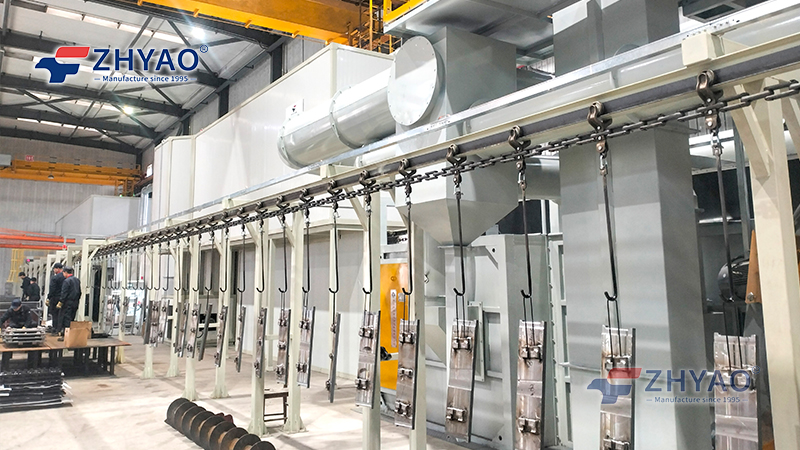
Increasing conveyor speed is one of the first measures considered when a production line needs more output. However, conveyor speed alone does not determine how many finished workpieces can be produced.
The distance between workpieces also matters.
If parts are spaced too far apart, fewer workpieces pass through the line within a given period. Reducing the spacing may increase throughput, but only when the spray equipment can still provide adequate coverage and the curing process can meet the required conditions.
Workpiece size and shape also affect the result. Large parts, complex structures and products with deep recesses may require more space or additional coating attention.
Before changing conveyor speed or spacing, check:
Whether the spray guns can maintain sufficient coverage at the proposed production rate.
Whether workpieces have enough clearance to avoid interference.
Whether the curing oven provides the required heating time.
Whether loading and unloading can keep pace with the conveyor.
A faster conveyor is useful only when the entire process can support it.
Spray Booth Capacity Must Match the Workpiece
The number of spray guns does not directly determine coating capacity.
A line processing simple, flat components may achieve high output with a relatively straightforward automatic spraying arrangement.
However, parts with complex shapes, different orientations or recessed areas may need more spraying positions, different gun arrangements or manual touch-up.
If workpieces move too quickly through the booth, some surfaces may receive insufficient powder coverage. Adding guns without considering their positions and spray patterns may not solve the problem either.
For high-volume production, the spraying system should be designed around the actual workpiece geometry, coating requirements and production speed.
The objective is not to install as many guns as possible. It is to achieve reliable coating coverage within the available spraying time.
Curing Capacity Is Often Overlooked
The curing oven is another important factor affecting production output.
A line may transport and coat workpieces quickly, but the curing process still needs sufficient time to bring the coating to the required conditions.
Oven capacity depends on several factors:
Workpiece dimensions, material and weight.
Required curing conditions of the powder.
Actual workpiece temperature, not just oven air temperature.
Conveyor speed and effective heating-zone length.
Oven loading density and heat distribution.
For example, increasing conveyor speed reduces the time each workpiece spends inside the oven. If the workpiece cannot reach and maintain the required curing conditions, coating performance may be affected.
Simply increasing the oven temperature is not always the right solution. The heating system, airflow, oven structure and workpiece thermal characteristics must be considered together.
For high-output production, curing capacity should be verified under realistic loading conditions rather than estimated from the oven's external dimensions alone.
Loading and Unloading Can Create Hidden Bottlenecks
Production capacity is also affected by operations before and after the main coating processes.
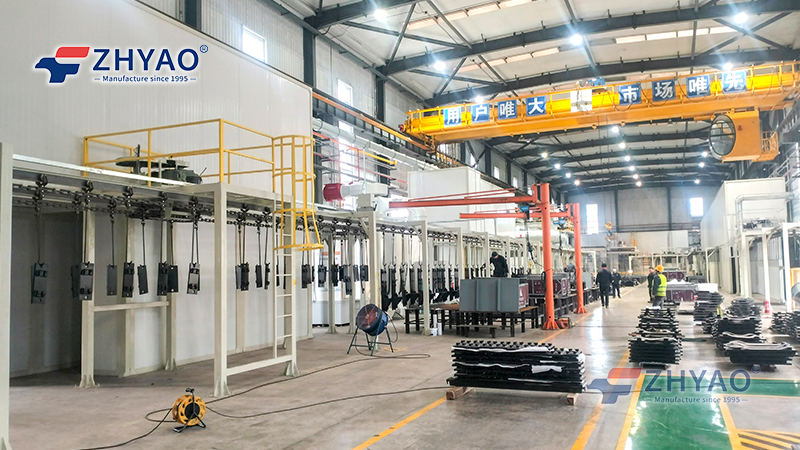
If operators cannot load workpieces quickly enough, the conveyor may have empty spaces. If unloading is too slow, finished parts may accumulate at the end of the line.
The problem becomes more noticeable when workpieces are large, heavy or difficult to handle.
The loading method, hanging fixtures, transfer equipment and unloading space should therefore be considered during line design.
For heavy or oversized workpieces, a ground rail conveyor or other suitable handling arrangement may be more appropriate than a conventional overhead conveyor. The choice depends on workpiece weight, dimensions, transport route and available factory space.
A coating line should be designed to move workpieces efficiently through the entire production process, including the handling stages that are sometimes overlooked.
How to Identify the Real Production Bottleneck
When actual output is lower than expected, increasing equipment capacity immediately is not always the best response.
A more reliable approach is to examine the production process in sequence.
Check the actual output of each stage.
Record how many workpieces are loaded, pretreated, coated, cured and unloaded within the same production period. This helps identify where output begins to fall.
Observe waiting time and workpiece accumulation.
A growing queue before a process may indicate insufficient capacity at that stage. Empty conveyor spaces after a process may suggest that upstream production is not keeping pace.
Check whether quality requirements are restricting speed.
If operators need to slow down the line to achieve proper coating coverage or curing, the issue may involve equipment configuration or process conditions rather than conveyor speed alone.
Evaluate the complete production cycle.
Consider workpiece loading, fixture changes, color changes, maintenance and other interruptions. A line's practical output is not the same as its theoretical maximum capacity.
These checks help determine whether the solution requires equipment adjustment, process improvement or a redesign of a specific section of the line.
Design the Line Around Stable Production, Not Maximum Speed
A high-output powder coating line should be designed around the actual product range and production requirements.
The conveyor, pretreatment system, spray booth, powder recovery system and curing oven must work within compatible operating conditions. Increasing the capacity of one section without checking the others can create new bottlenecks.
It is also important to consider future production changes. If workpiece sizes, product mix or daily output are expected to change, the design should allow reasonable flexibility without making the entire system unnecessarily complex.
The most effective production line is not necessarily the one with the highest conveyor speed or the largest equipment. It is the one that maintains a stable production rhythm while meeting coating quality requirements.
FAQ
Why does a powder coating line fail to reach its expected production capacity?
Common causes include insufficient pretreatment capacity, unsuitable conveyor spacing, limited spray coverage, inadequate curing time and slow loading or unloading. The actual bottleneck should be identified before increasing equipment speed.
Can increasing conveyor speed improve powder coating line output?
It can increase throughput when the spraying, curing and handling processes can support the higher speed. If these processes cannot keep pace, faster operation may reduce coating quality without delivering a meaningful increase in finished output.
What do you think of this article?
Copyright @ Hebei Zhanyao Intelligent Equipment Technology Co., Ltd. All Rights Reserved Record number:
Service Hotline


