Hello, welcome to the official website of Zhan Yao Spraying!

Customer service hotline
+86 185 3326 7656
WeChat:+8618533267656
Mobile:+86 185 3326 7656
Whatsapp:+8618533267656
Email:info@powder-coatingline.com
Address:No. 55, Airport Road, Changshou Street, Xinle City, Shijiazhuang, Hebei Province
An aluminum profile powder coating line may operate at a relatively high conveyor speed but still fail to achieve its expected production output.
The reason is that production efficiency depends on more than conveyor speed. Profile loading density, pretreatment time, spray gun coverage, and curing capacity all affect how many profiles can be processed reliably within a given period.
For aluminum extrusion manufacturers, these factors are closely connected. Increasing the loading quantity may reduce spraying accessibility, while increasing conveyor speed may affect pretreatment and curing conditions.
A productive coating line must therefore be designed around the relationship between workpiece characteristics and the capacity of each processing stage.
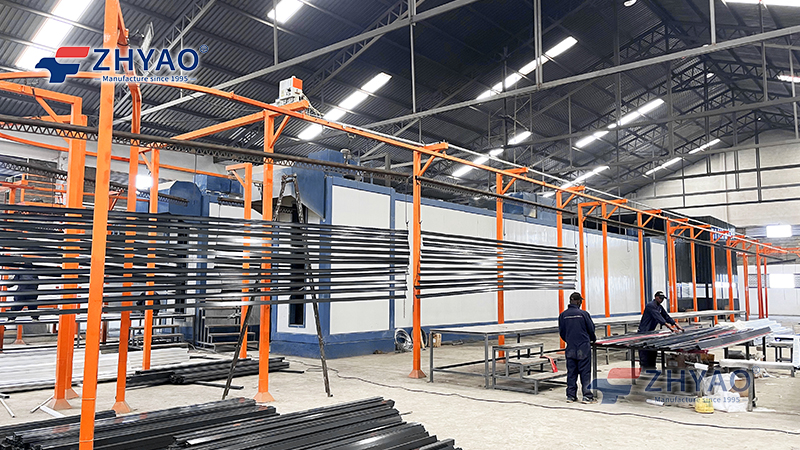
Why Conveyor Speed Does Not Equal Production Capacity
Conveyor speed is an important parameter, but it does not independently determine production output.
In aluminum profile production, the number of profiles carried by each hanger also has a significant influence on capacity.
For example, loading more profiles onto each hanger can increase the number of workpieces transported through the line without increasing conveyor speed. However, this arrangement must leave sufficient space for pretreatment liquids, rinsing, powder application, and airflow.
If profiles are positioned too closely, adjacent surfaces may interfere with spray gun access. This can create uneven powder distribution, especially around grooves, narrow sections, and recessed areas.
The relationship between conveyor speed and loading density should therefore be evaluated together.
The actual production target should be based on the number of profiles successfully processed per unit of time, not simply the speed of the conveyor.
Profile Loading Density Affects the Entire Coating Process
Aluminum profiles come in different lengths, cross-sections, and weights. Their geometry directly influences how they should be arranged on the conveyor.
Long profiles require stable support to prevent excessive movement during transportation. Their hanging orientation also affects how pretreatment liquids drain and how powder spray guns access different surfaces.
Cross-section geometry is equally important.
Some profiles have deep grooves, multiple cavities, or narrow internal sections. If several profiles are mounted too close together, these features may become difficult to reach during spraying.
The loading arrangement should consider:
Profile length and weight.
Cross-sectional shape and surface complexity.
Distance between adjacent profiles.
Hanger structure and supporting points.
Spray gun accessibility and liquid drainage.
A higher loading density is not always more efficient. If it causes coating defects or requires additional manual correction, the apparent increase in output may not translate into higher effective production capacity.
Pretreatment Must Match Profile Geometry
Pretreatment quality is essential for powder coating adhesion and long-term coating performance.
Aluminum profiles may require several treatment stages, depending on the alloy, incoming surface condition, coating specification, and applicable process requirements.
Typical processes may include degreasing, rinsing, chemical conversion treatment, and final rinsing.
The pretreatment line must provide sufficient treatment time and appropriate process conditions at the intended conveyor speed.
Profile orientation is another important consideration.
Complex cross-sections may contain cavities and recessed sections where treatment liquids can accumulate. If the hanging arrangement does not allow effective drainage, residual liquid may be carried into subsequent stages.
This can affect drying and potentially create coating quality problems.
The pretreatment system should therefore be designed around both the required chemical process and the physical characteristics of the profiles.
Increasing conveyor speed without validating treatment time, rinsing conditions, and drainage performance may compromise the entire coating process.
Spray Gun Arrangement Should Follow Profile Cross-Sections
Automatic powder spraying is commonly used in aluminum profile production because it supports repeatable coating application and reduces repetitive manual work.
However, the number of spray guns alone does not determine coating performance.
Their positions, spraying angles, movement range, and distance from the profiles must match the actual cross-sections being processed.
Flat or relatively simple profiles may be suitable for a more standardized automatic spraying arrangement.
Profiles with deep grooves, narrow recesses, and complicated geometries may require additional spray gun adjustment or manual touch-up.
The arrangement should also account for the electrostatic Faraday cage effect. Recessed areas and internal corners can be difficult to coat because the electric field and powder particle movement may favor more exposed surfaces.
Simply increasing voltage or powder output does not necessarily solve this problem.
A better approach is to evaluate representative profile samples, adjust gun positions and spraying parameters, and confirm the resulting coating distribution.
For factories processing multiple profile types, the spray system should provide sufficient adjustment flexibility rather than being optimized for only one cross-section.
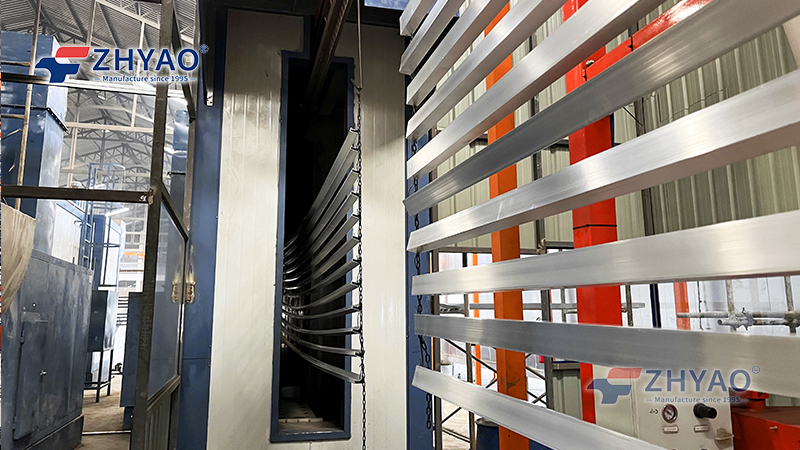
Curing Capacity Depends on Actual Workpiece Conditions
The curing oven is another major factor affecting production efficiency.
Aluminum profiles are generally lighter than heavy steel structures, but their heating behavior still depends on profile wall thickness, cross-sectional structure, loading density, and oven airflow.
The powder coating material determines the required curing conditions.
It is important to distinguish between oven air temperature and actual workpiece temperature. The specified curing time generally relates to the temperature reached by the coated workpiece, not simply the temperature displayed by the oven controller.
When conveyor speed increases, the available time inside the effective heating zone decreases.
If the profiles cannot reach and maintain the required curing conditions, increasing production speed may lead to insufficient curing.
Oven design should therefore consider:
Profile dimensions and wall thickness.
Number of profiles loaded on each hanger.
Required workpiece temperature and curing time.
Effective heating length.
Hot air circulation and temperature distribution.
Production loading conditions.
The oven should be validated under representative loading conditions rather than evaluated only by its empty operating temperature.
Material Handling Can Become a Hidden Production Bottleneck
Production efficiency does not end when profiles leave the curing oven.
After curing, profiles need suitable cooling conditions before handling, inspection, and packaging, according to the coating requirements.
Long aluminum profiles require stable support during unloading and transportation. Poor handling arrangements may cause surface scratches, deformation, or unnecessary manual work.
If the cooling and unloading areas cannot keep up with the conveyor, finished profiles may accumulate and interrupt production.
For continuous coating operations, the layout should include sufficient space for cooling, unloading, temporary storage, and finished-product handling.
These arrangements should be considered during the initial design stage instead of being added after the production line is installed.
How to Identify the Real Production Bottleneck
When an aluminum profile coating line cannot achieve its expected output, increasing the speed of the entire system is not necessarily the correct solution.
The first step is to identify which processing stage is limiting production.
Production issue | What should be checked |
|---|---|
Low output per conveyor cycle | Hanger loading quantity and profile spacing |
Uneven powder coverage | Profile cross-sections and spray gun accessibility |
Inconsistent pretreatment | Treatment time, chemical conditions, and drainage |
Insufficient curing | Actual workpiece temperature and effective heating time |
Finished profiles accumulate | Cooling, unloading, and handling capacity |
For example, if the spray booth cannot maintain consistent coverage when more profiles are loaded onto each hanger, increasing loading density may create more rework rather than improve effective output.
Similarly, if the curing oven is already operating near its process capacity, increasing conveyor speed may compromise coating performance.
The correct improvement depends on the actual bottleneck and its relationship with the other processing stages.
What Information Is Needed Before Designing the Line?
Before designing a new aluminum profile powder coating line or upgrading an existing system, manufacturers should prepare representative production information.
Important details include:
Aluminum profile drawings and cross-sections.
Minimum and maximum profile lengths.
Profile weight and wall thickness.
Typical hanger loading arrangements.
Expected production output per shift.
Surface pretreatment and coating requirements.
Powder colors and color change frequency.
Available workshop dimensions and installation conditions.
These details help determine the conveyor configuration, pretreatment capacity, automatic spray gun arrangement, powder recovery system, and curing oven requirements.
If the factory plans to process additional profile types in the future, their dimensions and production requirements should also be considered.
A coating line should have a clearly defined operating range so that future production changes do not immediately create equipment limitations.
Production Efficiency Comes From Matching Every Process
The efficiency of an aluminum profile powder coating line is determined by how well its processing stages work together.
Profile loading affects pretreatment access and spray coverage. Conveyor speed determines the available processing time.
The spraying arrangement influences coating consistency, while the curing oven determines whether the required thermal conditions can be maintained at the target output.
These factors cannot be optimized independently.
Instead of focusing only on conveyor speed or the number of automatic spray guns, manufacturers should evaluate the complete production flow and identify where capacity is actually being lost.
A properly matched system can maintain stable production while reducing unnecessary equipment investment and avoidable quality problems.
FAQ
1. How can production capacity be increased in an aluminum profile powder coating line?
Start by identifying the actual production bottleneck. Review hanger loading density, conveyor speed, pretreatment capacity, spray gun coverage, and curing conditions.
Improving the limiting stage is generally more effective than increasing the speed of the entire line without process validation.
2. Does increasing conveyor speed always improve aluminum profile coating efficiency?
No. Higher conveyor speed reduces the available processing time in pretreatment and curing stages. It may also affect spraying conditions. Conveyor speed should only be increased when all relevant equipment and process parameters can support the new operating conditions.
What do you think of this article?
Copyright @ Hebei Zhanyao Intelligent Equipment Technology Co., Ltd. All Rights Reserved Record number:
Service Hotline


