Hello, welcome to the official website of Zhan Yao Spraying!

Customer service hotline
+86 185 3326 7656
WeChat:+8618533267656
Mobile:+86 185 3326 7656
Whatsapp:+8618533267656
Email:info@powder-coatingline.com
Address:No. 55, Airport Road, Changshou Street, Xinle City, Shijiazhuang, Hebei Province
During powder coating, not all powder sprayed from the guns reaches the workpiece. Some particles pass around the part and become overspray.
Without an effective recovery system, this excess powder would accumulate inside the booth, spread into the surrounding workshop, or be lost through the exhaust.
A powder coating booth recovery system manages this overspray through controlled airflow, powder separation, and filtration. Depending on the system design, recovered powder may be collected for reuse, while fine particles are captured by filters to protect the exhaust system.
Understanding how these stages work together helps manufacturers select the right powder coating booth and maintain stable production.
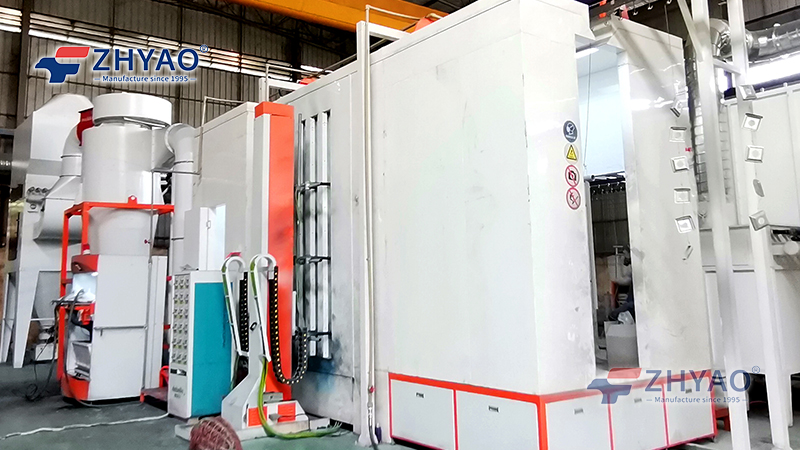
When powder guns spray a workpiece, electrostatic attraction helps powder particles adhere to the grounded metal surface. However, some particles do not reach the workpiece.
The recovery system uses an exhaust fan to create controlled airflow inside the spray booth. This airflow draws overspray toward the collection area and prevents powder from escaping through the booth openings.
The basic process is:
Powder Spraying → Overspray Collection → Powder Separation → Filtration → Powder Collection or Disposal
The exact arrangement depends on whether the booth uses a cyclone recovery system, a cartridge filter recovery system, or a combination of both.
A cyclone recovery system separates powder particles through centrifugal force. It is commonly used in powder coating lines that require continuous powder recovery and reuse.
The working process involves several stages.
Overspray Enters the Cyclone
Powder-laden air is drawn from the spray booth into the cyclone through a tangential inlet. This creates a rotating airflow inside the cyclone chamber.
Centrifugal Force Separates Powder Particles
As the air rotates, larger and heavier powder particles move toward the cyclone wall under centrifugal force. They gradually lose momentum and move downward toward the collection hopper.
The separated powder is collected at the bottom of the cyclone.
Air Moves to the Secondary Filtration Stage
Not all powder particles are separated by the cyclone. Fine particles remain suspended in the airflow and move toward the secondary filtration system.
This is why a cyclone recovery system normally works together with cartridge filters or another suitable final filtration stage. The cyclone alone should not be treated as a complete air filtration system.
Recovered Powder Is Collected for Reuse
Powder separated by the cyclone can be transferred to a collection container or powder supply system, depending on the equipment configuration.
Before reuse, the recovered powder must meet the required quality conditions. Contamination, mixed colors, moisture, or changes in powder properties can affect coating performance.
A cartridge filter recovery system uses filter elements to capture powder particles from the airflow.
Unlike a cyclone system, which separates powder through centrifugal force, a cartridge filter system relies primarily on filtration.
Powder-Laden Air Enters the Filter Chamber
The exhaust fan draws overspray from the booth into the filtration chamber. Air passes through the filter elements, while powder particles are retained on the filter surface.
Filtered Air Passes Through the Exhaust System
After filtration, the cleaned air moves through the exhaust duct or air circulation system, depending on the booth design.
The filtration system must be properly selected and maintained to control powder emissions and maintain the required airflow.
Pulse Cleaning Removes Accumulated Powder
As powder builds up on the filter surface, airflow resistance increases.
Many cartridge filter systems use compressed-air pulse cleaning to remove accumulated powder. Short bursts of compressed air dislodge powder from the filter surface, allowing it to fall into a collection hopper.
In systems designed for powder reclaim, this collected material may be transferred for further handling. However, not all filter-recovered powder is suitable for direct reuse. Its quality and contamination level must be evaluated.
In many industrial powder coating lines, cyclone separation and cartridge filtration are combined.
The two stages perform different functions:
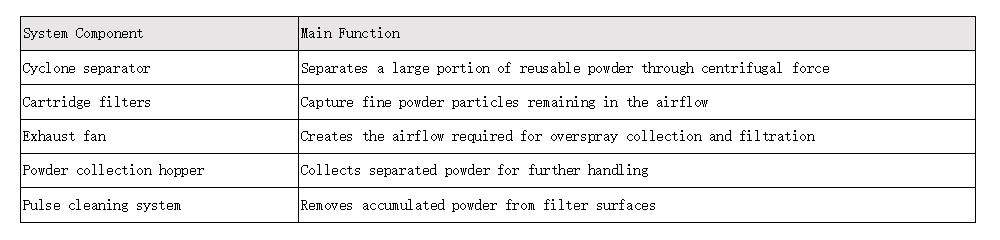
The cyclone handles the main powder separation, while the cartridge filters provide secondary filtration.
This arrangement can support continuous production and powder recovery, particularly when the same color is used for extended production runs.
However, the actual recovery performance depends on powder characteristics, airflow conditions, equipment design, and operating practices.
No. Powder collection and powder reuse are not the same thing.
The quality of recovered powder determines whether it can be returned to the production process.
Several factors need to be considered:
Color contamination: Powder from different colors must not be mixed if the finished coating requires consistent color appearance.
Foreign particles: Dust, oil, metal particles, and other contaminants can affect the final coating surface.
Powder condition: Moisture or changes in powder flow characteristics may make recovered powder unsuitable for reuse.
Recovery source: Powder collected from different stages of the recovery system may have different quality characteristics.
For applications with strict appearance requirements, manufacturers may need to limit the proportion of reclaimed powder or use fresh powder for certain production runs.
The appropriate reuse ratio should be determined through powder supplier recommendations and actual coating quality tests, rather than applying one fixed percentage to every project.
A recovery system does not operate independently of the spray booth. Its performance depends on several connected factors.
Airflow Design
The exhaust fan, booth openings, ductwork, and internal airflow arrangement must work together. Insufficient or uneven airflow can allow overspray to escape or accumulate in unwanted areas.
Filter Condition
As filters become loaded with powder, airflow resistance changes. If pulse cleaning is ineffective or filters are damaged, the system may struggle to maintain stable operating conditions.
Cyclone and Duct Design
The cyclone structure, inlet arrangement, and connecting ducts affect powder separation and transportation. Poorly designed connections can lead to powder accumulation or unstable airflow.
Powder Characteristics
Different powder formulations may have different particle sizes, flow characteristics, and separation behavior. These properties influence how effectively the recovery equipment handles overspray.
Cleaning and Maintenance
Powder buildup inside ducts, hoppers, and collection equipment can affect operation. Regular inspection and cleaning are especially important when changing colors or handling different powder types.
The right recovery configuration depends on production volume, color change frequency, powder reuse requirements, and the expected operating pattern.
A cyclone-based recovery system is worth considering when production involves relatively long runs of the same color and continuous powder recovery is important.
A cartridge filter system may be more practical for certain production arrangements where direct filtration and straightforward equipment configuration are priorities.
For applications involving frequent color changes, booth cleaning requirements and the risk of cross-contamination become particularly important. The recovery system should be designed around the actual color schedule rather than selected only by its powder collection capacity.
Ultimately, a powder coating booth recovery system should be evaluated as part of the complete spraying and ventilation arrangement.
The goal is not simply to collect more overspray, but to maintain stable booth airflow, protect the working environment, and recover powder without compromising coating quality.
1. What is the difference between a cyclone and a cartridge filter powder recovery system?
A cyclone separates powder particles using centrifugal force, while a cartridge filter captures fine particles through filtration. Cyclone systems are often combined with cartridge filters to provide both powder separation and final air filtration.
2. Can powder collected by a recovery system be reused directly?
Not always. Recovered powder must be checked for color contamination, foreign particles, and changes in material condition. Only powder that meets the required quality conditions should be returned to production.
What do you think of this article?
Copyright @ Hebei Zhanyao Intelligent Equipment Technology Co., Ltd. All Rights Reserved Record number:
Service Hotline


