Hello, welcome to the official website of Zhan Yao Spraying!

Customer service hotline
+86 185 3326 7656
WeChat:+8618533267656
Mobile:+86 185 3326 7656
Whatsapp:+8618533267656
Email:info@powder-coatingline.com
Address:No. 55, Airport Road, Changshou Street, Xinle City, Shijiazhuang, Hebei Province
Producing multiple colors on the same powder coating line creates challenges that do not usually exist in single-color production. Every color change can involve equipment cleaning, powder replacement, recovery system adjustments, and production downtime.
A common mistake is to focus only on how quickly the spray booth can change colors. In practice, the entire powder coating system must be designed to handle different colors without compromising coating quality or production efficiency.
The first step is to understand the factory's color production plan. This determines whether dedicated spray booths, a shared booth, or a combination of both will be more suitable.
Start with the Actual Color Production Plan
Before selecting equipment, manufacturers should evaluate how many colors they produce, how frequently colors change, and the average batch size for each color.
For example, a factory producing three major colors in large batches has different requirements from one producing ten colors in small quantities.
The main factors to consider include:
Number of colors and their production proportions.
Average batch size for each color.
Color change frequency per shift.
Workpiece dimensions and coating requirements.
Required production capacity.
If several colors account for most of the production volume, dedicated spraying stations may be worth considering. If many colors are produced in relatively small batches, a shared spray booth with a suitable cleaning system may be more economical.
Production scheduling also matters. Grouping workpieces by color can reduce unnecessary changeovers and improve equipment utilization without increasing the initial investment.
Choose Between Dedicated and Shared Spray Booths
The spray booth configuration is one of the most important decisions in multi-color powder coating line design.
Dedicated Spray Booths
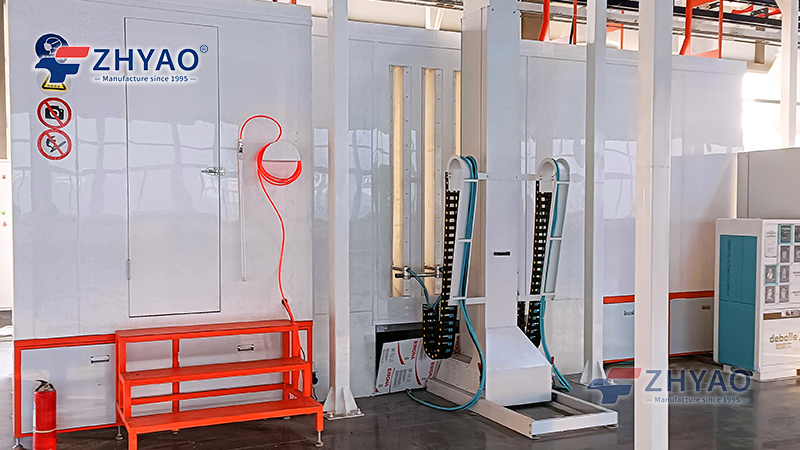
Dedicated spray booths assign different colors to separate spraying stations. Each booth can have its own powder supply and recovery arrangement.
This configuration is suitable when:
Major colors have stable and relatively large production volumes.
Frequent color changes would interrupt production.
Strict color separation is required.
Its main advantage is reduced cleaning downtime and more stable production scheduling.
However, dedicated booths require more factory space and higher equipment investment. Separate booths also do not automatically eliminate cross-contamination risks. Powder supply, workpiece handling, and recovery arrangements still need to be considered.
Shared Spray Booths
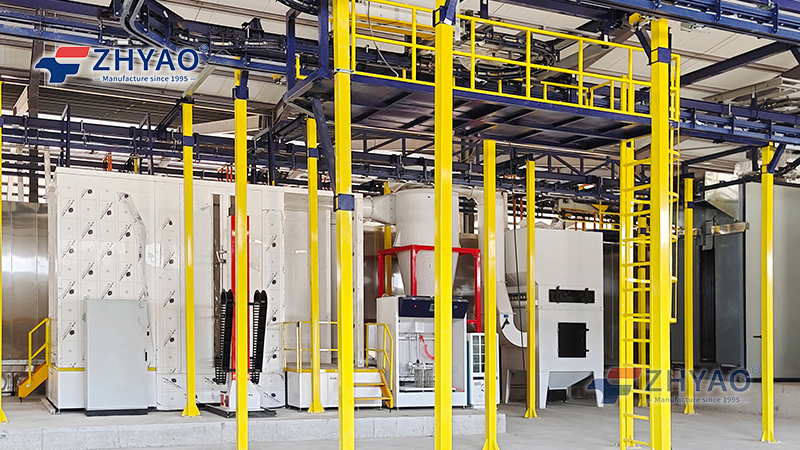
A shared spray booth handles different colors through cleaning and powder changeover procedures.
It generally requires less installation space and can reduce initial equipment costs. It is often suitable for manufacturers producing smaller batches with frequent changes between colors.
The limitation is cleaning time. Residual powder may remain in the booth, spray guns, hoses, and recovery equipment.
Therefore, a shared booth must be designed with accessible cleaning surfaces, convenient powder connections, and an appropriate recovery arrangement.
Neither configuration is universally better. The decision should depend on the balance between color change frequency, batch size, production continuity, and investment.
Real Project: Automatic Powder Coating Line for Shelving Components in Australia
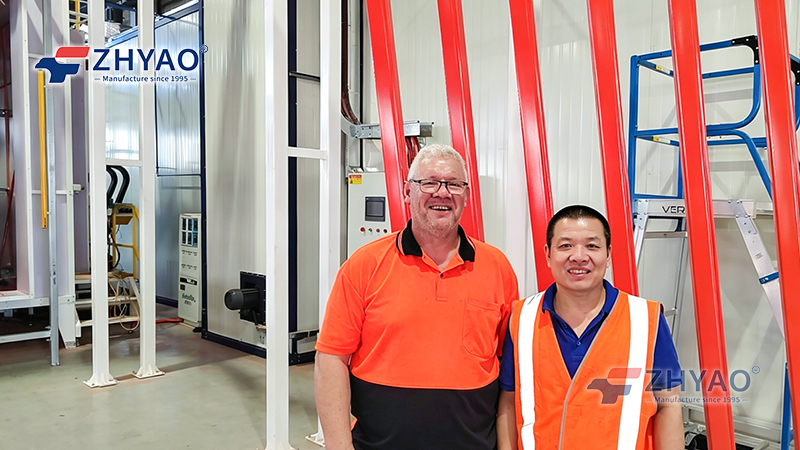
ZHYAO supplied an automatic powder coating line for metal shelving components in Australia.
For this type of application, workpiece dimensions, hanging arrangements, spraying coverage, and conveyor spacing all influence equipment configuration.
The project demonstrates an important principle in coating line engineering: equipment should be designed around actual products and production requirements rather than simply combining standard machines.
When planning a line for shelving components, the spraying system, conveyor, and curing oven must work together to maintain a stable production process.
Design Powder Supply and Recovery to Prevent Color Contamination
Powder supply and recovery are particularly important in multi-color production.
Even after cleaning the spray booth, residual powder may remain in hoses, pumps, feed equipment, filters, and recovery components. If this powder enters the next color batch, it can affect the final coating appearance.
For dedicated spray booths, separate powder hoppers, feed equipment, and recovery systems can help maintain color separation.
For shared booths, the powder supply system should allow convenient cleaning and replacement of color-contact components.
Recovery arrangements also need careful consideration. Dedicated recovery systems are often preferable when color purity is critical. With shared recovery, the cleaning process and reuse of recovered powder must be evaluated carefully.
In some applications, using virgin powder after a color change may be more appropriate than risking contamination from previously recovered powder.
This decision involves a trade-off between powder consumption, cleaning time, and coating quality.
Coordinate the Conveyor, Pretreatment, and Curing Systems
A multi-color powder coating line should not be designed around the spray booth alone.
The conveyor determines how workpieces move between pretreatment, spraying, curing, and unloading. If different colors use separate spraying stations, the conveyor layout must allow the correct workpieces to reach the corresponding stations.
For production involving different batches and workpiece types, an accumulation and release conveyor may offer more flexibility than a simple continuous conveying arrangement.
Pretreatment and curing capacity must also match the planned production rate. Adding more spray booths will not increase finished output if the pretreatment system or curing oven becomes the bottleneck.
Different powder formulations may also have different curing requirements. Their specifications should be checked before deciding whether they can share the same curing conditions.
The goal is to balance the capacity of every major process stage rather than maximizing the spraying capacity alone.
Choose the Right Level of Spraying Automation
Not every multi-color powder coating line needs to be fully automatic.
For large batches of similar workpieces, automatic spray guns and reciprocators can reduce repetitive manual operations and maintain consistent spraying patterns.
For smaller batches or products with significantly different geometries, manual spraying may offer greater flexibility.
A combination of automatic and manual spraying is also practical. Automatic guns can handle the main surfaces, while operators perform touch-up on recessed areas, corners, and complex structures.
The appropriate configuration depends on workpiece geometry, production volume, coating requirements, color change frequency, and investment budget.
The objective is not to automate every operation, but to automate the processes that provide measurable production value.
FAQ
1. Can one powder coating booth handle multiple colors?
Yes. A shared booth can handle multiple colors when it is designed for effective cleaning and powder changeover. The powder supply and recovery systems must also be considered to prevent residual powder from contaminating subsequent colors.
2. Is a separate powder recovery system necessary for each color?
Not always. Separate recovery systems are preferable when strict color separation is required or when colors are produced frequently. Shared recovery may be possible in some applications, but cleaning requirements and recovered powder reuse must be carefully evaluated.
What do you think of this article?
Copyright @ Hebei Zhanyao Intelligent Equipment Technology Co., Ltd. All Rights Reserved Record number:
Service Hotline


