Hello, welcome to the official website of Zhan Yao Spraying!

Customer service hotline
+86 185 3326 7656
WeChat:+8618533267656
Mobile:+86 185 3326 7656
Whatsapp:+8618533267656
Email:info@powder-coatingline.com
Address:No. 55, Airport Road, Changshou Street, Xinle City, Shijiazhuang, Hebei Province
Project Background
The client is a steel fire door manufacturer supplying fire-rated door leaves and frames to commercial and residential construction projects. Fire doors are large, flat, thermally heavy steel assemblies: two pressed steel skins welded around a mineral core, with hinge reinforcements, lock cutouts and vision
panel openings machined before finishing.
The plant had been finishing doors with manual liquid paint inside the general production hall. Film thickness varied between operators and between the two faces of the same leaf; edges and recesses around hinge and lock preparations were thinly covered and began showing corrosion during
on-site storage; solvent odour and VOC emissions were becoming a compliance issue; and the finishing step had become the bottleneck limiting monthly output.
The client decided to convert the door finishing process to powder coating and required a complete turnkey line — pretreatment, drying, powder application, curing and conveyor transport — engineered as one coordinated system rather than as separate pieces of equipment.
Client Challenges
Four constraints shaped the engineering work:
Heavy, thermally massive workpieces. A fire door leaf stores far more heat than a thin sheet-metal part. If oven residence time is based on surface temperature alone, the door skin can reach cure temperature while the steel mass below it is still heating — and the actual cure state differs across the leaf.
Two visible faces and strict edge coverage. Both faces of a fire door are visible after installation. Hanging marks, thin film at the bottom edge, or uneven gloss between the two faces are grounds for rejection. Hinge recesses, lock cutouts and frame returns need coverage that single-direction spraying cannot guarantee.
Mixed product flow. The line must handle different door heights and widths, thicker reinforced leaves, and door frames within the same shift, without long color-change or changeover stops.
Compliance and throughput together. The client needed to remove VOC emissions from the finishing area and at the same time raise daily output — meaning line speed, pretreatment stage count and oven length had to be balanced against each other rather than sized independently.
ZHYAO Engineering Solution
The line was laid out as a single overhead-conveyor loop through five coordinated stages.
Pretreatment. A multi-stage spray tunnel was configured for the steel substrate: alkaline degreasing, rinsing, surface conditioning, phosphate conversion coating (the chemistry selected with the client's paint supplier according to local water quality and the required corrosion class), and a final rinse. The tunnel is enclosed and ventilated so wash water and mist stay inside the process area.
Dry-off. A dry-off oven removes moisture from all surfaces before powder application, including recesses, cutouts and the bottom edge of the leaf where water collects after the wash stages.
Conveyor and racking. An overhead chain conveyor carries purpose-built door hangers. The hanger geometry was designed around the door leaf: doors hang vertically with both faces fully exposed, and the contact points sit on areas that are later covered by hardware or the frame rebate, so no visible hanging marks remain on finished surfaces. Hanger spacing defines the conveyor pitch against which the rest of the line is sized.
Powder booth. The booth is sized to the largest door leaf plus its hanger envelope. Automatic reciprocators with flat-spray nozzles cover the main faces at controlled film build; a manual touch-up station behind the booth handles hinge recesses, lock cutouts, edges and frame returns. Gun output is zoned and triggered by part detection, so no powder is sprayed into the gaps between doors. The booth supports the client's standard RAL colors with a fast color-change procedure for mixed production.
Curing oven. The oven is the stage where fire door geometry matters most. A straight-through curing oven with an extended heating zone is used: residence time is set not by skin temperature but by the time the whole steel section needs to reach and hold cure temperature. Conveyor speed, oven length and door pitch are matched so that every door, whatever its gauge, receives full cure at line rate. Insulated panels and controlled exhaust limit heat loss through the oven shell.
All five stages run on one line control system: conveyor speed, gun triggering, oven dwell and pretreatment stage timing are synchronized from a single panel, and the operator interface shows the current position of every door in the loop.
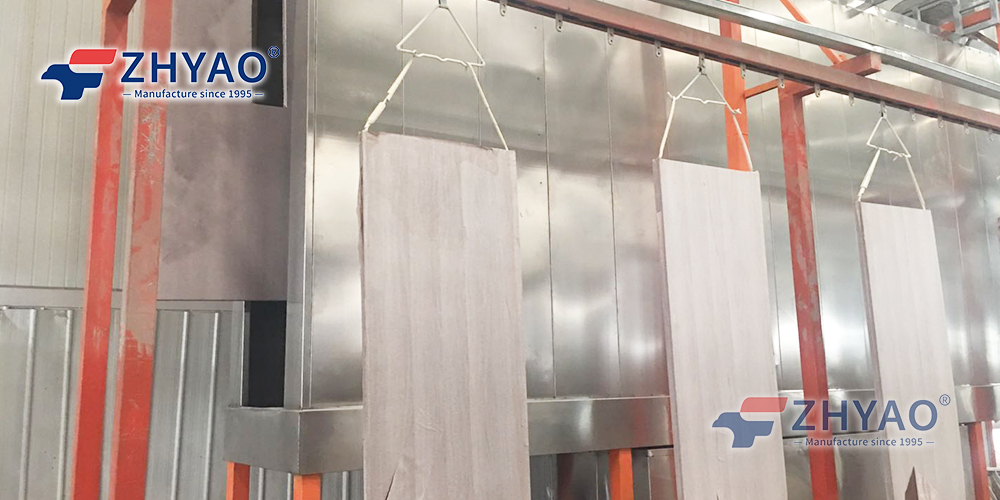
System Advantages
- Cure matched to thermal mass. Oven dwell is derived from the door section mass, not surface temperature alone, so the finish cures uniformly across both faces and the edges.
- Both faces finished in one pass. Hanger design and double-sided gun coverage eliminate manual re-spraying of the second face and remove visible hanging marks from finished surfaces.
- Edge coverage corrected before curing. The manual touch-up station is positioned where operators can reach recesses while the powder is still receptive, so coverage at cutouts is corrected before the oven rather than after rejection.
- VOC eliminated from the finishing area. Powder coating removes the solvent emissions and odor that the previous liquid process produced inside the production hall.
- One line, mixed products. Doors of different sizes, gauges and frame sections run in the same pitch; color change is handled inside the booth without stopping the conveyor.
- Line-wide synchronization. Because conveyor, booth and oven are controlled as one system, output can be increased by adjusting line speed while the process window is maintained.
Application Scope
The same system configuration applies to:
- Steel fire-rated door leaves and fire door frames
- Security doors and armored door leaves
- Pressed steel door skins supplied to door assemblers
- Clean-room doors and industrial passage doors
- Other large, flat, thermally heavy steel fabrications such as switchgear cabinets and machine covers
Engineering Summary
For flat, heavy steel products such as fire doors, a finishing line cannot be selected piece by piece. The pretreatment stage count determines corrosion performance; the hanger geometry determines face quality and hanging-mark control; the booth and gun layout determine film uniformity on two visible faces; and the oven must be sized for the thermal mass of the door, not only for its surface area. When these four elements are engineered against one conveyor pitch, the line delivers a consistent finish at the rated output — without a manual liquid-paint fallback.
If you manufacture fire doors or similar large steel leaves and are evaluating a move to powder coating, send us your door dimensions, leaf weight, required daily output and available hall size. ZHYAO will return a line layout proposal with process stages, conveyor pitch and oven sizing for your specific product — not a standard quotation.
What do you think of this article?
Copyright @ Hebei Zhanyao Intelligent Equipment Technology Co., Ltd. All Rights Reserved Record number:
Service Hotline


